Dr Triage / Corrections
Care that stays on-site.
Designed for jails, prisons, and detention systems where transport is expensive, custody is fragile, and audits never stop.
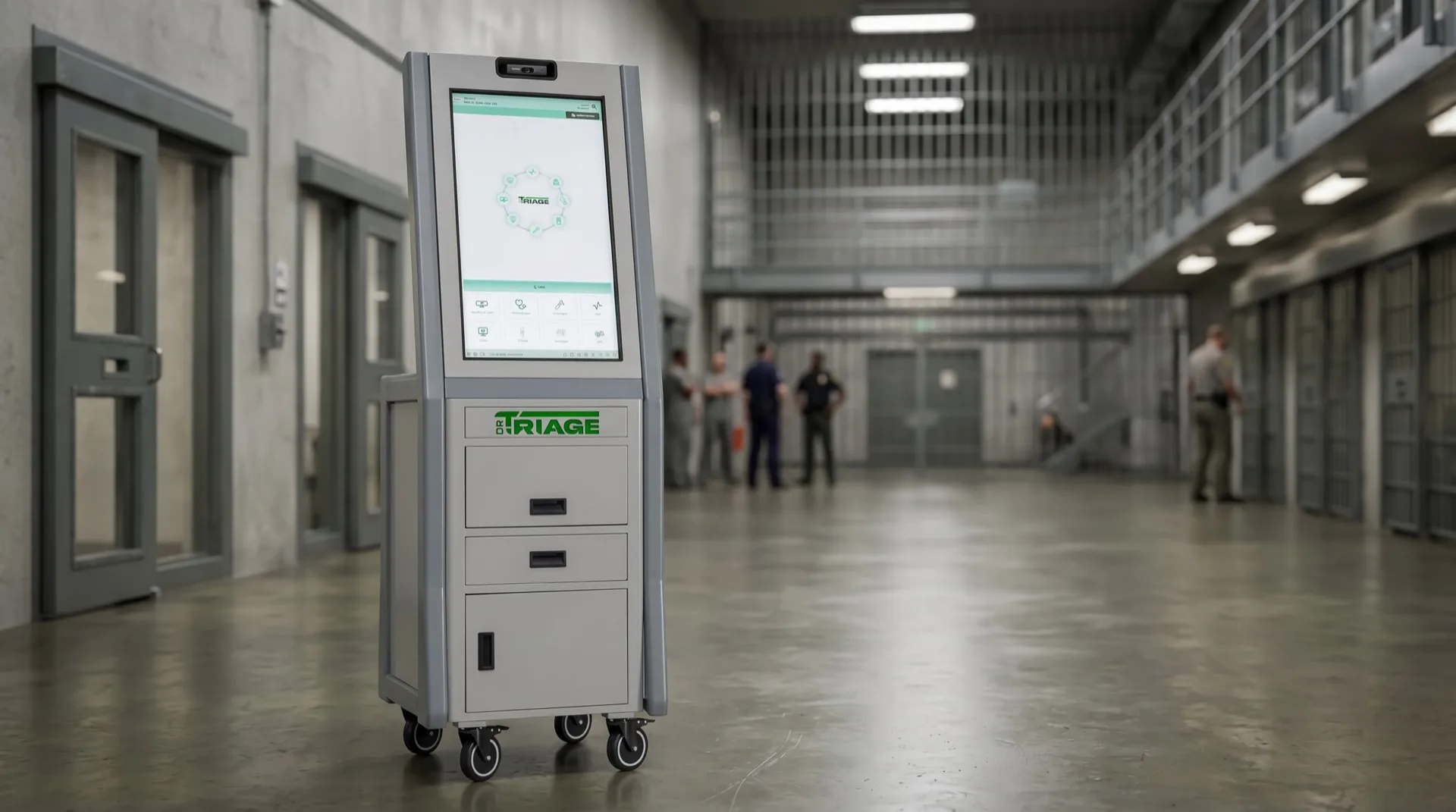
Every offsite trip pulls officers off post, ties up a secure vehicle, and stretches continuous custody, often for care that could have stayed on-site. Dr Triage is designed to change the default: the MDU in-facility with 24/7 virtual providers on secure video, so most clinical calls are designed to end in an on-site treatment plan, not a transport. All clinical decisions are made by licensed providers.
What Actually Changes in the Facility
Fewer Offsite Transports
Provider decisions land in-facility: less escort time, fewer exposure events, lower custody risk on the road.
24/7 Virtual Coverage
Licensed virtual providers on secure video around the clock, designed so staff are not sending patients out just to be safe.
Audit-Ready Encounters
Every consult timestamped, attributed, and documented in the Dr Triage EMR. Built for NCCHC and ACA review.
Independent Corrections Programs Show the Same Pattern
~$2,000
Approximate cost to guard a patient transported to outside medical care for a 24-hour period, excluding the hospital bill.
Urban Institute, 2013 dollars
1 in 4
eConsults resolved without any offsite transport.
LA County Correctional Health Services, 15 facilities, 2022-2025, via NCCHC
$1,500
Security and vehicle costs avoided each time an eConsult eliminates a transport.
LA County Correctional Health Services, via NCCHC
Figures above are from independent corrections programs (Urban Institute; Los Angeles County Correctional Health Services eConsult program, via NCCHC), cited for industry context. They are not Dr Triage outcomes.
How This Lands Across the Corrections Market
County Jails
The intake desk is the front line. Treat it that way.
County jails handle the highest patient churn in corrections: new bookings every shift, unknown histories at intake, and small teams covering nights and weekends. Most of the acuity that ends in a transport starts at booking or in housing, or at 2 a.m., not at daytime sick call.
Dr Triage is designed to put a licensed virtual provider on the unit in minutes, diagnostics already running, so the decision happens on-site rather than in transit. For pre-trial populations, where missed care drives the highest liability, that speed matters. For the sheriff, it means fewer officers off post on a shift you are already short on.
State Prisons
Built for the audit cycle and the aging population on the yard.
State systems carry the longest length of stay, the highest chronic care load, and the deepest documentation expectations under NCCHC and ACA standards. The hard problem is less the cost of one trip than the drag of repeat transports for acute-but-stable issues that could have stayed on-site, and the audit prep that follows each one.
Dr Triage is designed to anchor a longitudinal record across years of incarceration: timestamped notes, provider attribution, and the diagnostic data behind each decision, all in the Dr Triage EMR. For an NCCHC site visit, the audit trail builds as encounters happen. For an aging population, on-site depth is designed to shift care from reactive transports to a managed-care posture.
Federal & Detention Facilities
Documentation cadence and contract fit, not just clinical coverage.
Federal and detention settings answer to a higher bar: PBNDS, NCCHC, and federal contract standards stack on top of standard correctional health requirements. Every offsite transport adds reporting, custody risk, and sometimes public scrutiny, and detention populations turn over on immigration timelines that compress the documentation window.
Dr Triage is designed to tighten the on-site loop and produce documentation at the depth federal monitors expect: timestamped, provider-attributed, tied to the diagnostic data behind each call. The model is designed to fit existing federal procurement vehicles, and the 24/7 provider pool is built so licensure coverage matches the facility population.
Multi-Site Systems
Solve the rural-site staffing problem from the rest of the system.
Multi-site systems (regional jail authorities, sheriff’s offices, and state DOCs) face an unevenness problem: the smallest, most rural sites are the hardest to staff and the most expensive per transport, while the largest set a standard the rural ones cannot match. The result is care variance and an audit story that is harder to tell in aggregate.
Dr Triage is designed as a system-level program, not a facility-by-facility pilot. One 24/7 virtual provider pool covers every site, so the smallest rural facility carries the same after-hours depth as the largest urban one. Documentation lives in one Dr Triage EMR across the system, making cross-facility benchmarking and consolidated audit prep easier. Procurement becomes one platform conversation, not ten.
See it inside your facility.
drtriage.com · 1-855-4-HEAL-ALL · The Right Care. Anytime. Anywhere.