Proximedicine for disaster response
In place before the disaster, ready when it hits.
The Dr Triage briefcase, a prototype in development: a portable diagnostic platform with 24/7 licensed provider oversight, pre-positioned so care is there first.
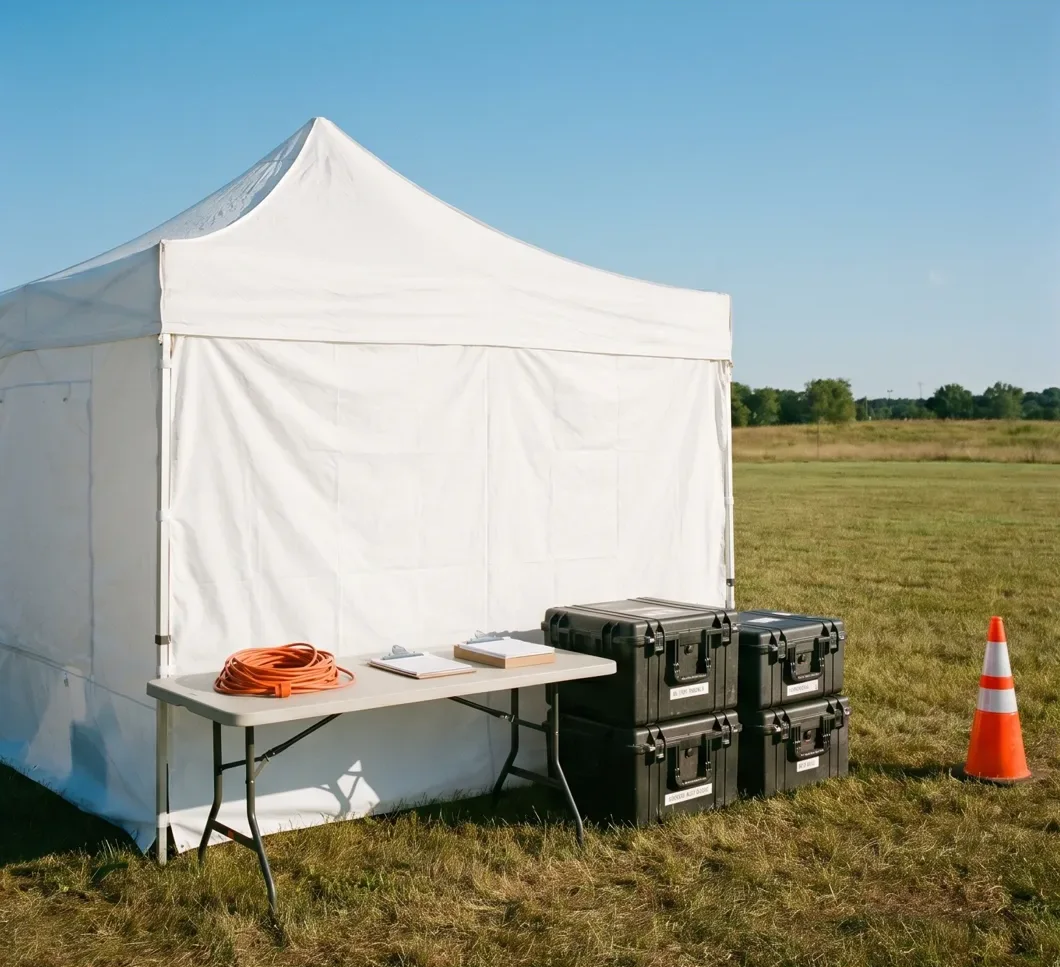
Disasters follow the same pattern: clinical capability arrives after the event, once people have already gone days without care. The Dr Triage briefcase is being built on the opposite premise: pre-positioned with responders and community partners, so care is there first, not racing to catch up.
The Disaster Gap, in Numbers
90
Major disaster declarations in 2024, nearly double the 30-year average.
FEMA / IIED, 2025
11M
Americans displaced by U.S. disasters in 2024, a record.
IDMC, 2025
24-96h
Window before outside medical help arrives after a sudden-impact event.
Hick et al.
84-90%
Post-disaster healthcare demand that is ambulatory, not trauma.
Hick et al.
Figures are from the named primary sources cited on our Disclosures & Sources page. They describe the conditions the Dr Triage briefcase is being designed to meet.
What the Briefcase Is Being Built For
Portable by design.
Staged in advance, in the vehicle, the cache, the partner site. When the event hits, the capability is already there.
Provider on screen.
Open the briefcase and a licensed provider joins by secure video over cellular or satellite. The operator runs diagnostics; the provider supports the decision and the documentation.
Continuity that survives the disaster.
Encounters are documented at the time of care and designed to route into local records, federal systems, or NGO patient-tracking once connectivity returns.
Site Deployment
Pre-positioned inside the frameworks responders already use. Illustrative, not exhaustive.
Federal response systems
FEMA staging areas · HHS ASPR / NDMS · Federal Medical Stations · DMAT and IMSURT teams
State and county
State emergency operations centers · County EMA shelters · Public health field programs
First responder agencies
Fire, EMS, search and rescue · Wildland fire camps · Mass casualty staging
Disaster relief NGOs
American Red Cross shelters · Salvation Army · Faith-based response · Mutual aid networks
Military medical units
Austere-environment teams · Forward operating sites · National Guard medical detachments
International humanitarian partners
NGO and inter-agency response · Refugee health · Mobile medical units in conflict-affected areas
Built to Equip the Front Line
Coverage before federal support lands
For FEMA, HHS ASPR / NDMS, and the federal teams that build the response.
Outside medical support typically takes 24 to 96 hours to arrive. The briefcase is being designed to cover the hours before it does. We’re inviting federal partners to shape how it fits existing protocols.
Local capacity below the federal line
For state and county emergency management and the public health teams beside them.
Most disasters are local before they’re federal, and never get a DMAT. The briefcase is being designed for state and county pre-positioning, alongside existing EMS and public health.
Clinical backup for the people doing the work
For fire, EMS, search and rescue, and the NGOs running shelters and field stations.
The first responder is often the most senior clinical resource a survivor sees for a day or two. The briefcase is being designed to give them a clinical answer between a call too big to take alone and a transfer they can’t easily make.
For environments where infrastructure can’t be assumed
For National Guard medical units and the teams planning for distributed operations.
Military medicine is moving toward distributed, small-footprint capability. The briefcase’s portable form and provider oversight fit that direction. These scenarios are beyond Dr Triage’s current operating envelope, so we’re open to early, design-level conversations.
Be there first.
drtriage.com · 1-855-4-HEAL-ALL · The Right Care. Anytime. Anywhere.